Crop and cultivation assessment
Irrigation strategy reflects crop demand and soil, hydroponic or substrate production.
CONTROLLED WATER DELIVERY AT THE RIGHT TIME
We design greenhouse irrigation systems around the crop, cultivation method, irrigation zones, water source and operating requirements.
Water preparation, pumping, filtration, distribution lines, valves and sensors are assessed as one coordinated system.
Greenhouse irrigation design starts with the crop and cultivation method. Soil-based production depends on soil water holding and drainage, while hydroponic and substrate systems involve different root volumes, application frequency and return-water strategies. Growth stages and greenhouse compartments define which areas need independent control. Irrigation automation distributes water; nutrient recipes and dosing remain a separate fertigation function.
Available flow, pressure and water quality establish the hydraulic basis. Suspended solids, hardness and other relevant characteristics are reviewed through appropriate analysis, and filtration or pretreatment is selected for the project. Pump selection also considers pipe lengths, elevation differences, simultaneous zones and the pressure required by application devices.
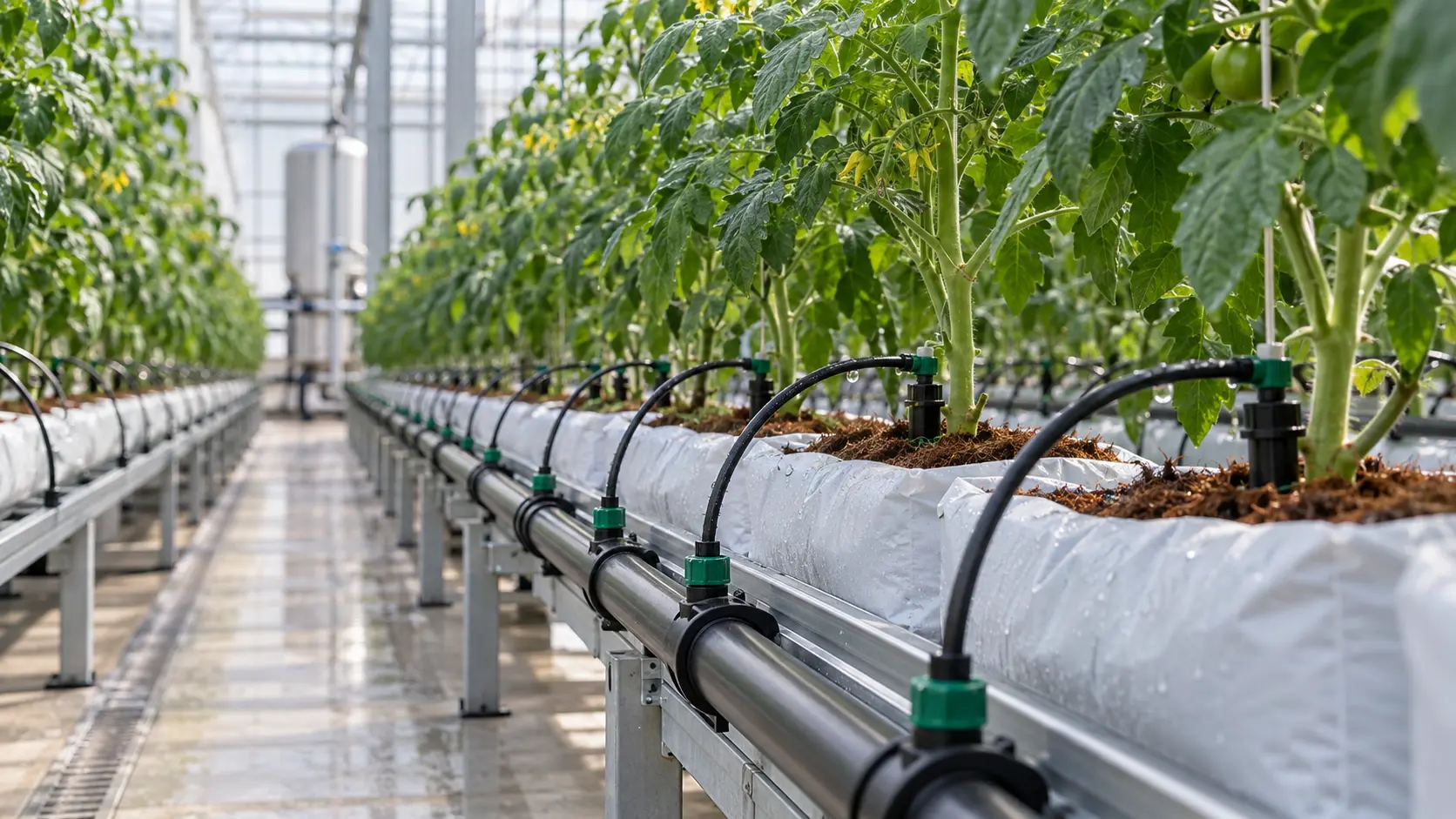
Main and branch lines, valve groups and drip laterals are planned to carry the calculated flow to each zone. A greenhouse drip irrigation system or another application device is selected for the crop layout. Pipe sizes, regulation and zone dimensions are coordinated to manage pressure differences. Manual operation and automated scenarios are both defined.
Automated greenhouse irrigation may respond to time, applied volume or suitable sensor data. Root-zone moisture, substrate condition, tank level, line pressure, flow and drainage can be monitored when relevant. After installation, lines are flushed; pressure, leakage, valves, sensors and operating parameters are tested with the operating team.
GREENHOUSE IRRIGATION AUTOMATION
Irrigation strategy reflects crop demand and soil, hydroponic or substrate production.
Source reliability and analysis guide filtration and preparation.
Simultaneous zones, line losses and emitter pressure are calculated.
Equipment is matched to water properties and the hydraulic duty point.
Pipe sizes and routes carry controlled flow to the zones.
Production areas are divided for independent timing and control.
Relevant flow, pressure, moisture or level data connect to controls.
Lines, valves, sensors and scenarios are checked after installation.
CONTROLLED WATER DELIVERY AT THE RIGHT TIME
Crop, method, area and operating expectations are recorded.
Quality, flow, pressure, levels and existing services are reviewed.
Demand and zones are established for production areas and scenarios.
Pumps, filters, pipes, valves and emitters are selected.
Distribution lines and automation connections are completed.
Lines are flushed and flows, pressure and automatic operation tested.
The schedule is established after reviewing the site, water infrastructure, greenhouse area and selected equipment.
INTEGRATED GREENHOUSE TECHNOLOGIES
Supplying water alone is not enough. Flow, pressure, distribution balance, zones, valves and root-zone sensors work together. Irrigation automation can interface with fertigation, while water delivery and nutrient dosing retain separate functions.
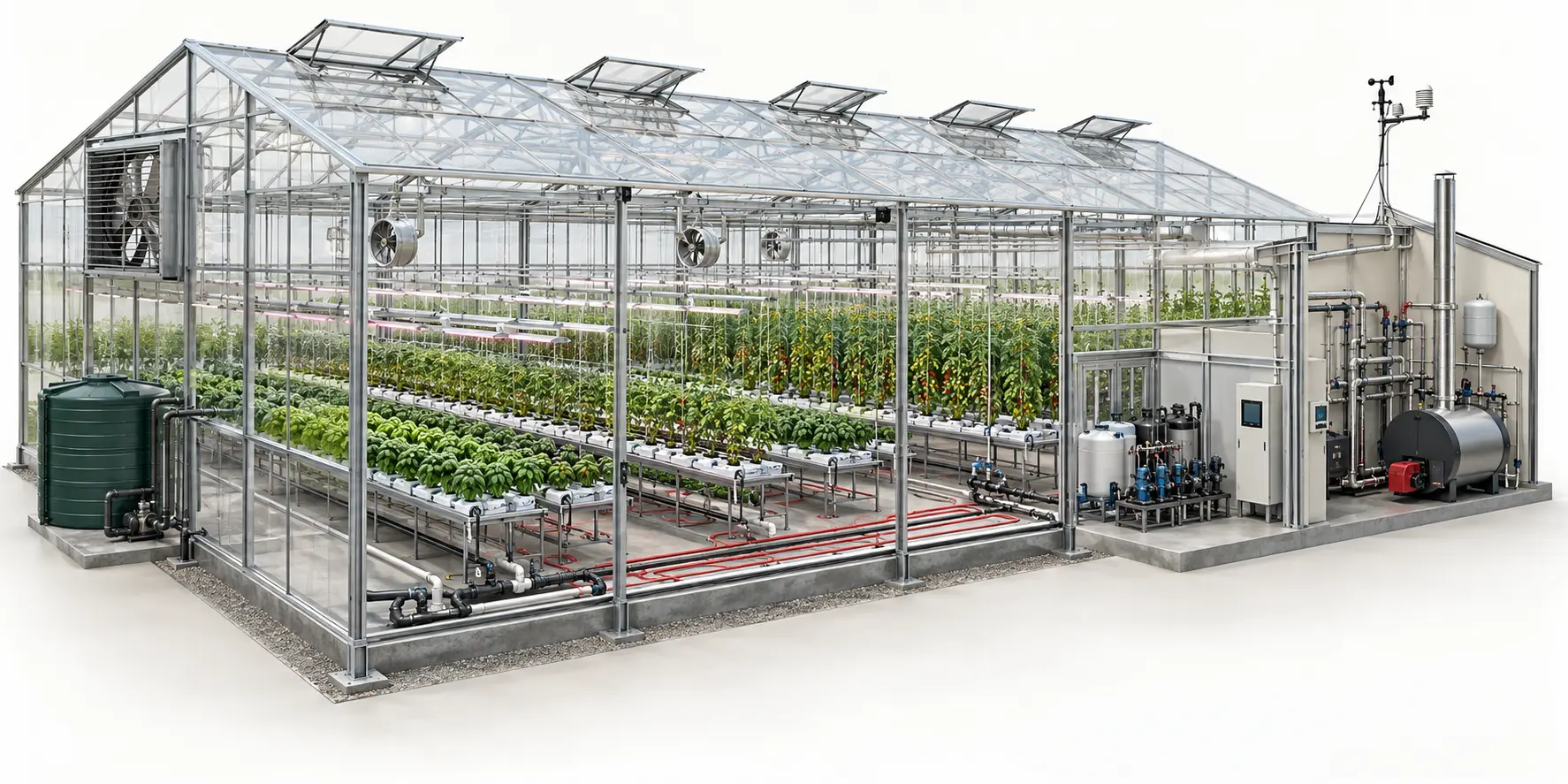
Irrigation Automation: Precise, automatic water distribution.
Equipment and controls are selected by assessing the production model and site data together.
No single arrangement suits every project; equipment and controls are selected for the site, water source and production needs.
Laterals, emitter spacing and pressure suit the crop layout.
Flow, timing and drainage monitoring are coordinated for frequent applications.
Application points align with root volume and gutter layout.
Pumping and filtration match hydraulic and water conditions.
Valve groups manage independent area flow and timing.
Suitable field sensors and meters provide data for control.
Coordinated lines and emitters help manage variation within a zone.
Pumps, pipes, filters and valves are calculated together.
Time, volume and sensor data support monitoring and adjustment.
Future zones can be considered in mains and controls.
Crop, method, source, area, zones and hydraulic losses are assessed together.
Crop, stage, climate, growing medium and application data are reviewed.
It is an area managed by an independent valve and schedule.
Existing pipes, pumps, filters, valves and controls must first be assessed.
Delivery, frequency, drainage and controls differ, so designs are not assumed to be the same.
Moisture, flow, pressure, tank-level or drainage measurements may be used.
It influences filtration, maintenance, clogging risk and possible pretreatment.
Crop, method, area, zones, water analysis, source flow, pressure and levels are useful initially.
LET’S PLAN YOUR PROJECT
Share your requirements for a new greenhouse or an existing facility. Our technical team will contact you to develop a practical solution plan.