Crop and climate-target assessment
Operating temperature and humidity goals are translated into technical scope.
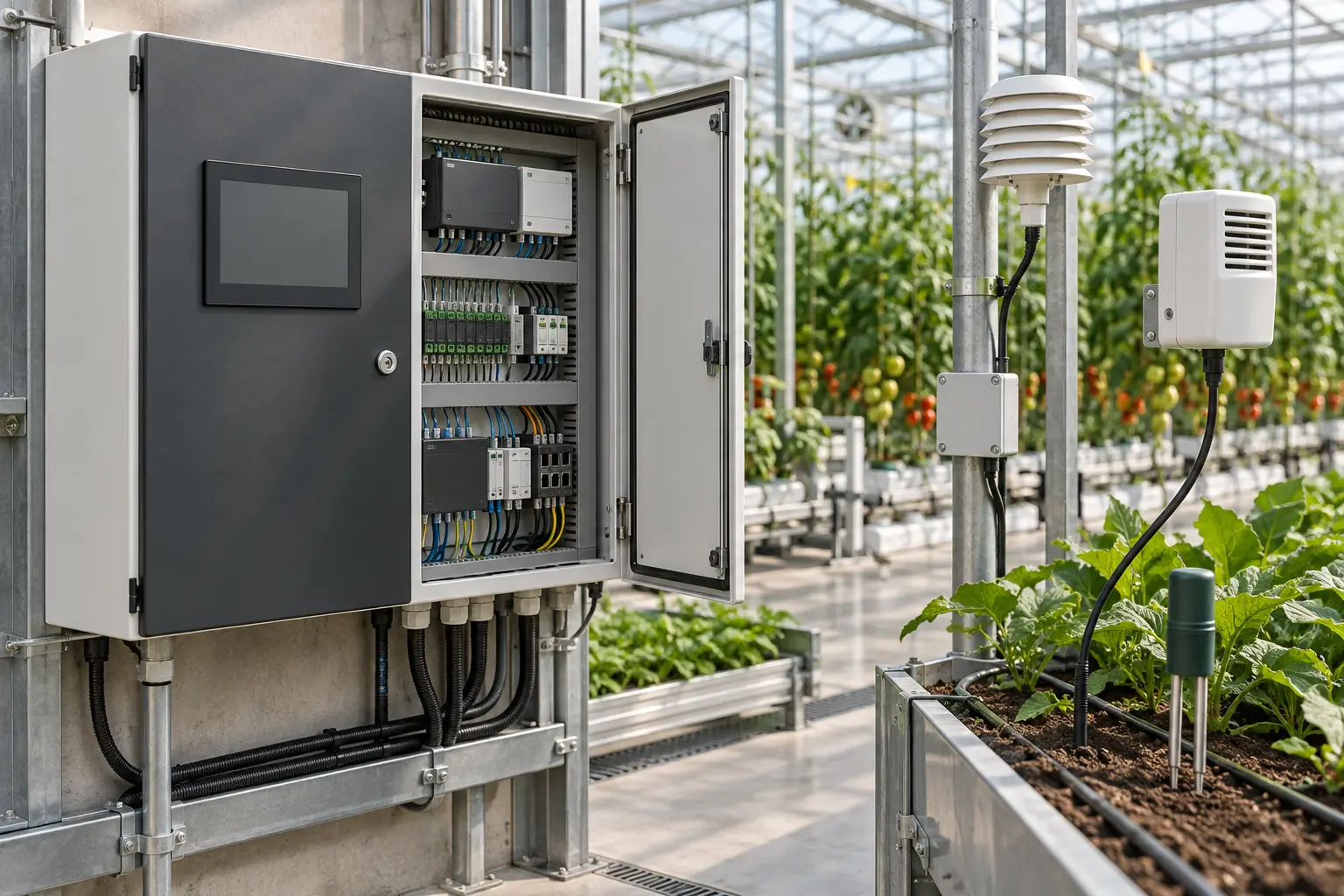
MEASURE, CONTROL AND MANAGE THE GROWING ENVIRONMENT
We design greenhouse climate control and automation systems around crop environmental needs, greenhouse structure, regional climate and operating scenarios.
Sensor data enables ventilation, shading, cooling, heating and other connected systems to be managed through a central control structure.
Greenhouse environmental control starts by defining crop temperature and relative-humidity needs across growth stages. Location, orientation, volume and covering are assessed with outdoor temperature, humidity, wind and solar load. These inputs shape natural ventilation through roof and side vents, mechanical ventilation requirements and control zones. VPD may help interpret the relationship between plant and air moisture, but its target varies with crop and stage and does not determine every control decision on its own.
Air exchange and circulation serve different purposes. Roof and side vents exchange air with outdoors, while circulation fans help manage local variations. Exhaust fans, fan-pad evaporative cooling, fogging, shading and energy screens are assessed against indoor and outdoor conditions. Fogging requires particular review of humidity, water quality, droplet characteristics and ventilation capacity.
Temperature and humidity sensors are placed where they represent crop level and control zones. CO₂ sensors may be included for measurement and monitoring when required; this does not imply a CO₂ enrichment service. The controller compares readings with targets, schedules and safety conditions. Ventilation, shading, fans, cooling and connected heating are prioritised to prevent conflicting commands.
Central automation may exchange status or commands with irrigation, fertigation and LED lighting where suitable interfaces exist. Alarms, logging and remote monitoring support operator oversight. Manual intervention and safe states are defined during design; automation is not treated as flawless operation without human supervision. Commissioning tests sensors, field connections, scenarios, alarms and local control behaviour.
GREENHOUSE CLIMATE CONTROL AND AUTOMATION SYSTEMS
Operating temperature and humidity goals are translated into technical scope.
Volume, covering, orientation, wind, humidity and solar load are assessed.
Roof and side vents plus fan and circulation needs are evaluated.
Screens, fan-pad or fogging are considered for site conditions.
Representative temperature, humidity and other required locations are planned.
Panels, actuators, connections and manual-operation needs are defined.
Screens, user roles, warnings and monitoring layers are specified.
Priorities, safe states, alarms and connected equipment responses are tested.
MEASURE, CONTROL AND MANAGE THE GROWING ENVIRONMENT
Crop, stage, structure, existing equipment and daily expectations are recorded.
Location, temperature, humidity, wind, solar load and existing vents are reviewed.
Area targets, measurement points and operating priorities are established.
Measurement, panels, field devices, communications and scenarios are planned.
Sensors and actuators are installed and connected-system interfaces completed.
Automatic and manual actions, interlocks, records and warnings are tested.
The schedule is set after greenhouse, site, connected equipment, automation scope and operating scenarios are reviewed.
INTEGRATED GREENHOUSE TECHNOLOGIES
Sensors provide inputs to control scenarios, not just displayed values. Representative temperature and humidity readings coordinate vents, screens, fans, cooling and heating while avoiding conflicting commands. Alarms, logging, manual intervention and integration with irrigation, fertigation and LED lighting complete the central system.
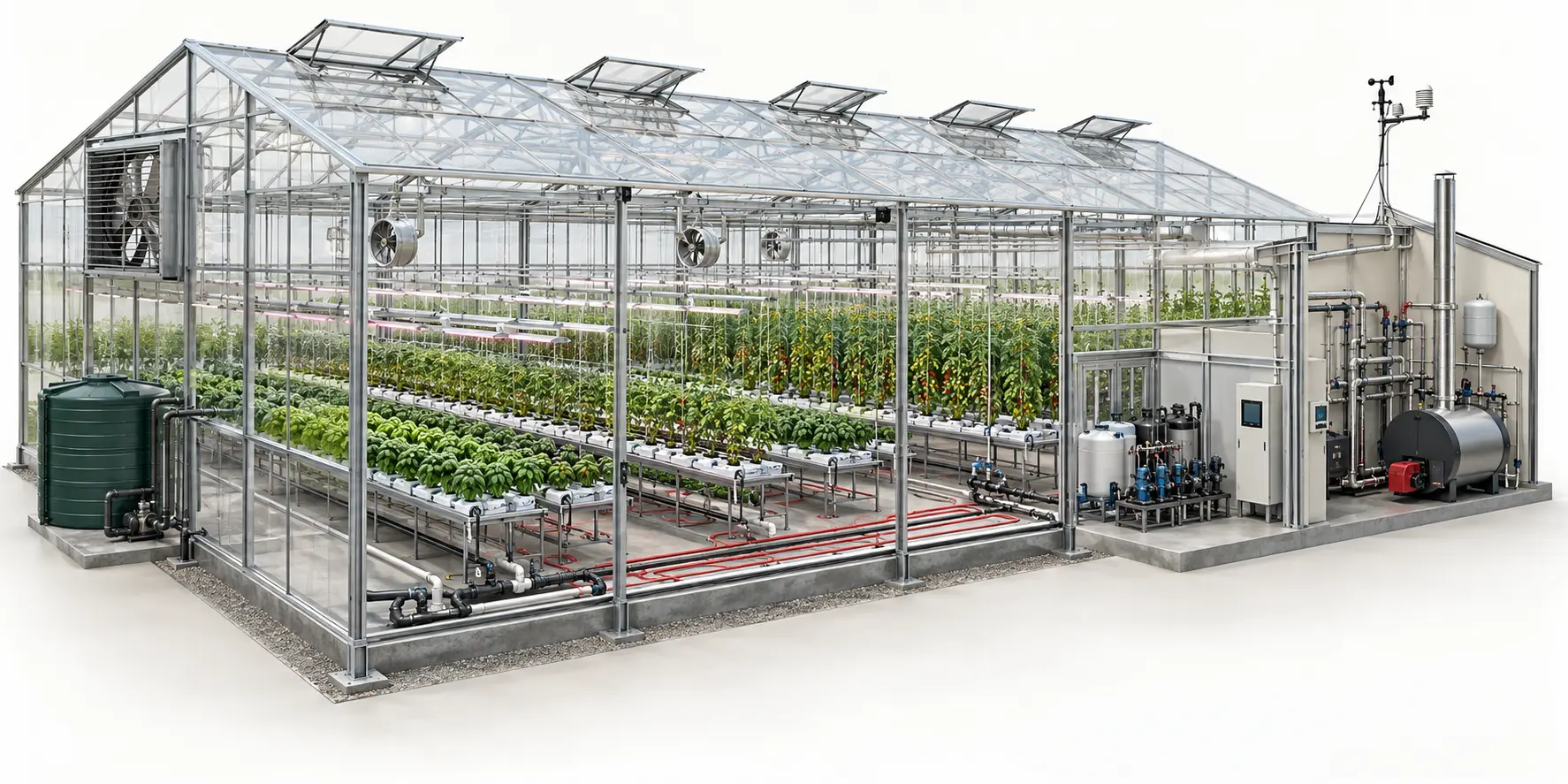
Climate & Automation: Central monitoring and control with sensors.
Equipment and control depth are selected by assessing crop requirements with structural and regional conditions.
Not every solution is required in every project. Selection depends on crop, structure, outdoor climate, existing equipment and operating goals.
Vents can respond to wind, rain, temperature and defined safety conditions.
Fan layouts are assessed for internal movement or mechanical air exchange.
Considered where outdoor conditions, water quality and airflow are suitable.
Humidity, water, droplet size and ventilation capacity are reviewed together.
Screen movement may coordinate with solar load, temperature and other equipment.
Representative sensors measure conditions; CO₂ is treated here as monitoring.
Heating commands are related to ventilation and climate targets without duplicating heating design.
Targets, equipment, alarms and records for separate areas share one interface.
Central control forms a traceable decision chain from measurement to field command.
Temperature, humidity and other defined measurements reach the controller.
Schedules, priorities, interlocks and safe conditions are processed together.
Vents, screens, fans, cooling or heating receive appropriate commands.
Operating state, alarms and logged data appear in the user interface.
Depending on the project, control may combine a local panel, industrial communications, network connectivity and cloud-based monitoring layers.
These are examples. Actual thresholds, delays and priorities are defined for the crop, site and project.
Connected equipment works toward common targets while conflicting commands are prevented.
Sensor values, states and command history can be reviewed.
Defined deviations become visible and decisions remain with the operator.
Future zones, sensors and compatible equipment can be considered during design.
Sensor placement, maintenance and fault behaviour form part of automation quality; points are selected to represent greenhouse conditions.
Crop targets, structure, outdoor climate, ventilation capacity, equipment, sensors and operating scenarios are assessed together.
Depending on scope, it can manage vents, fans, screens, cooling, heating and other connected systems through suitable interfaces.
At representative crop and zone locations protected from direct sun, water, heat sources and local drafts.
Options follow review of equipment, panels, field connections, mechanical condition and control compatibility.
Status, alarms and history can be available remotely when project infrastructure and connectivity support it.
Suitable interfaces allow coordination under common targets and conflict-prevention rules.
Behaviour is designed around architecture, local programming, backup methods and project requirements, with appropriate alarms.
Crop, dimensions, location, covering, outdoor climate, existing equipment, electrical systems, targets and remote-access needs are required.
LET’S PLAN YOUR PROJECT
Share your requirements for a new greenhouse or an existing facility. Our technical team will contact you to develop a practical solution plan.